
-
University
21 Kosmonavtov Boulevard,
Brest, Belarus 224016
Phone number:
+375 162 37‑00‑96
box@brsu.by -
Faculties
-
Education
21 Kosmonavtov Boulevard, Room 217/1, Brest, 224016, Belarus
+ 375 162 37-01-27
marzans@brsu.by -
Science
21 Kosmonavtov Boulevard, Brest, 224016, Belarus, Room 207
+375 162 21-66-86
nis@brsu.by
inovac@brsu.by -
International activities
21 Kosmonavtov Boulevard, Academic building № 1, Room 117, Brest, 224016, Belarus
Phone numbers: +375 162 37-01-29
+375 29 21-06-115
int@brsu.by - Services
General information
From the first steps to a new reality
Brest State A.S. Pushkin University is a leading educational, scientific and cultural center of the first region, providing training for specialists in various fields. It opened its doors in 1945, when, after the end of the Great Patriotic War, the Belarusian authorities and people faced goals not only to restore the state, but also to develop education. The first higher education institution in the southwestern Polesia region was established to train teaching staff. The Teacher Training Institute in the border city of Brest was founded by Resolution No. 801 of the Council of People's Commissars of the BSSR dated June 6, 1945.


According to the staffing table, the first lecturer of the new educational institution was Lidia Yefimovna Nemtsova. At that time, the educational process was carried out across three departments. People of different ages studied together. Among the first graduates was Georgy Petrovich Andreyuk, the future rector of the Brest Pedagogical A.S. Pushkin Institute, who graduated with honors. The name of the great Russian poet was given to the educational institution in 1950.


Education was in demand by society, and the faculty of the institute was replenished with specialists, new textbooks were acquired, and new classrooms were created. Over time, the number of faculties and departments increased, new academic buildings and dormitories were opened, and the material and technical base was strengthened. Research activities began to play a major role in the educational process. Both teachers and students were engaged in it. The first professor of BrSU was Vladimir Andreevich Kolesnik, and Stepan Georgievich Kondratenya was the first Doctor of Physical and Mathematical Sciences.


A significant event for BrSU, all its faculty and students — the change in status of the educational institution. In 1995, the institute was renamed a university. However, the name of A.S. Pushkin was lost. But a few years later, thanks to the efforts of Rector Vladimir Anestievich Pletyukhov, the name was returned to the university.
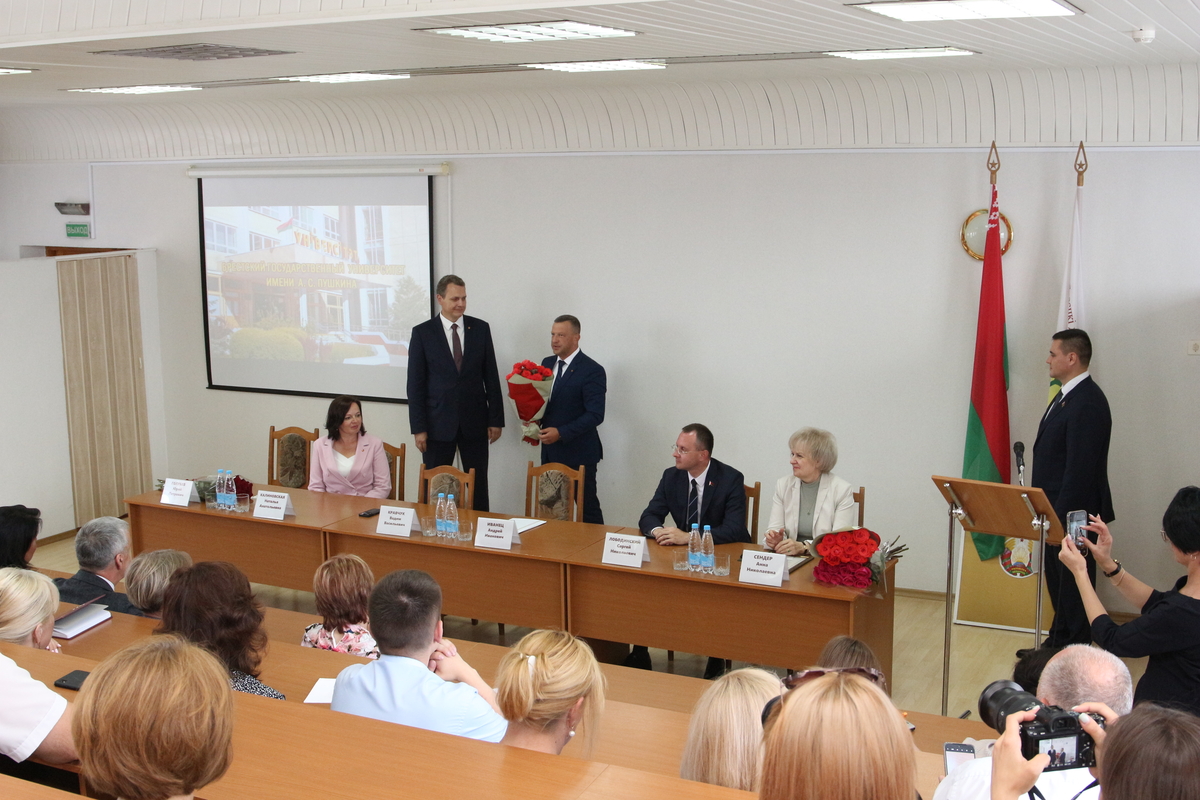
In accordance with Order No. 133-к of the Minister of Education of the Republic of Belarus dated July 28, 2023,
Yury Petrovich Holubeu, Candidate of Technical Sciences (PhD), Associate Professor, was appointed Rector of the University
By the new century, Brest State A.S. Pushkin University had undergone improvements in all areas of its activities. Training began for specialists not only in pedagogy, but also in social sciences, scientific research, and law. Later, the university started training journalists and urban planners. Thus, today the university provides multidisciplinary training of personnel. International and interregional cooperation is expanding, scientific research is being conducted, new specializations, laboratories and centers are being opened. Students actively engage in public activities and enhance the image of BrSU.


Today, the university consistently develops educational traditions, combining classical academic values with modern approaches to teaching, research, and youth education. It serves as a platform for implementing innovative educational and scientific projects, actively cooperating with educational institutions, research organizations, and international partners. Its activities have received high recognition. For achieving significant results in the quality and competitiveness of educational services and scientific products, as well as for implementing innovative technologies and management methods, by Resolution No. 171 of the Council of Ministers of the Republic of Belarus dated March 1, 2017, the educational institution "Brest State University named after A.S. Pushkin" was awarded the Prize of the Government of the Republic of Belarus for achievements in quality. Subsequently, the university has twice reaffirmed this award.


The staff and students are proud of the history and opportunities of BrSU and are confident that the new pages of the university's history will be no less bright and inspiring.


Infrastructure and Educational Environment
The structure of the university includes:
- 8 faculties (Faculty of Philology, Faculty of Physics and Mathematics, Faculty of History, Faculty of Law, Faculty of Pedagogy and Psychology, Faculty of Foreign Languages, Faculty of Physical Education and Sports, Faculty of Natural Sciences);
- 23 departments;
- Master's and postgraduate studies;
- Institute of Advanced Training and Retraining;
- a separate structural unit of Pinsk College.


Master's degree programs are a completed stage of education and training at the higher education level, which ensures the formation of knowledge, skills, and abilities in scientific-pedagogical and research work, with the conferral of a Master's degree. At BrSU, Master's degree programs are offered in 24 specializations. The educational process can be conducted in Russian and English.
The goal of training highly qualified scientific personnel in the university's doctoral (postgraduate) programs is to prepare a reserve of teaching staff for BrSU departments, as well as for other educational institutions and organizations. Training is provided in 15 specializations.

Archaeological practice of students of the Faculty of History
The Institute of Advanced Training and Retraining provides professional development in 9 profiles and 18 educational directions, as well as retraining in 19 specializations at the higher education level and in 2 specializations at the secondary specialized education level. It should be noted that 53.7% of the university's full-time teaching staff hold academic degrees and/or titles.


Pinsk College, as a structural subdivision of the university, trains specialists with secondary specialized education in the following specializations: "Primary Education", "Preschool Education", "Foreign Language (English, German)", "Music Education", "Tourism and Hospitality".
The educational process at the university is aimed at training competitive specialists who will possess fundamental knowledge and practice-oriented skills.

Laboratory classes on biotechnology
The educational potential of Brest State University named after A.S. Pushkin is shaped by specialized educational and scientific-educational facilities: a geology classroom, the V.A. Kolesnik Educational Center, a courtroom, the Russian Center, a STEM Center, the "Botanical Exhibitions" department, the Institute of Advanced Training and Retraining, the Confucius Institute, the Museum of the History of Physical Culture, the Biological Museum, the Winter Garden and the Continuous Flowering Garden, modern faculty laboratories, and the "School-Family" scientific-methodological center.
This infrastructure ensures the practical orientation of specialist training and expands opportunities for students' research work.


Scientific activity
By a joint decision of the State Committee on Science and Technology and the National Academy of Sciences of Belarus, Brest State University named after A.S. Pushkin has been accredited as a scientific organization. The university's research work encompasses fundamental and applied research in the fields of natural sciences, humanities, and socio-economic sciences. The university successfully operates a system for training highly qualified scientific personnel: each year, faculty members defend dissertations for the academic degrees of Candidate of Sciences (PhD) and Doctor of Sciences.


The university successfully operates the following scientific-pedagogical schools:
- "Pedagogy and Methodology of Higher Education" (Head – Doctor of Pedagogical Sciences, Professor Anna Nikolaevna Sender);
- "Practical Psychology of Childhood" (Head – Doctor of Psychological Sciences, Professor Irina Evgenievna Valitova);
- "Psychology of the Cognizing Subject" (Head – Doctor of Psychological Sciences, Associate Professor Elena Ivanovna Medvedskaya);
- "Nominative and Functional Linguistics" (Head – Doctor of Philological Sciences, Professor Vasily Ivanovich Senkevich);
- "Belarusian Historical-Functional Literary Studies: Theory and Practice of Interpreting a Work of Art" (Head – Doctor of Philological Sciences, Professor Zoya Petrovna Melnikova);
- "The Great Patriotic War in the Historical Memory of the Belarusian People" (Head – Doctor of Historical Sciences, Professor Vladimir Vasilyevich Zdanovich);
- "History, Culture and Religion of the Western Belarusian Lands" (Head – Doctor of Historical Sciences, Professor Alexander Nikolaevich Vabishchevich);
- "Regional Studies and Tourism" (Head – Candidate of Geographical Sciences (PhD), Associate Professor Alexander Alexandrovich Sidorovich).


All scientific schools are united by the mobilization of scientific potential, ensuring the continuity of scientific traditions, supporting the research of young scientists, and implementing research results into the educational process and practical activities.
In order to coordinate scientific, educational, and methodological activities, the university has established a Scientific-Methodological Council. One of the key priorities of its work is to foster methodological and pedagogical culture among faculty members.
The university has more than 100 student research associations, including research circles, laboratories, and research groups. Among the leading research directions are studies in territorial management, social processes, legal relations, and other relevant scientific fields. The coordination of young researchers' work is carried out by the Council of Young Scientists. University students actively participate in republican and international scientific competitions and projects. Every year, over 85% of the research papers submitted by undergraduate and graduate students to the Republican Student Research Competition receive a category award.
International partnership
Building and strengthening the university's reputation in the global educational space and ensuring the process of internationalization are key factors in establishing partnerships with educational institutions and organizations in foreign countries. BrSU's partnerships encompass educational institutions in Europe, Asia, and Africa. Among the key international partners are Anhui University, which hosts the Center for Belarusian Studies established with the participation of Brest State A.S. Pushkin University, Lomonosov Moscow State University, HSE University (Higher School of Economics) (Russian Federation), Tajik National University (Republic of Tajikistan), and Mirzo Ulugbek National University of Uzbekistan (Republic of Uzbekistan).

Lecture by Professor I.A. Shved for students of Anhui University
Within the framework of bilateral agreements, student and teacher academic exchange programs, as well as summer schools, have been organized. Lecturers from leading partner universities are invited to give lectures. Joint research, scientific-practical, and educational events are conducted with educational and scientific organizations from foreign countries.
The expansion of partnerships, exchange of best practices, and strengthening of internationalization are facilitated by Brest State University named after A.S. Pushkin's membership in authoritative international associations:
- International Consortium "Human Well-being in the Digital Environment of 'Smart' Cities";
- Scientific-Educational Consortium between higher educational institutions and research institutes of the Republic of Belarus and the Republic of Kazakhstan;
- Eurasian Association of Universities;
- Association of Vocational Education Universities (within the framework of the "Belt and Road" initiative);
- China-Belarus Association of Universities.


Recently, BrSU has entered several prestigious international and national rankings. It holds a high position in the Moscow International University Ranking "Three University Missions". All rankings can be viewed in the "International Rankings" section.
In recent years, Brest State A.S. Pushkin University has trained more than 1,000 highly qualified specialists from among foreign citizens.
We train, develop, educate
Every teacher at Brest State A.S. Pushkin University, in their classes, fulfills all the functions assigned to them for the education, development, and upbringing of the younger generation. The university has developed a comprehensive system of educational and extracurricular work aimed at the holistic development of the student's personality. Ideological and educational work is organized at a high level. It is aimed at:
- fostering citizenship, patriotism, and national identity based on state ideology;
- preparing young people for independent life and work;
- developing moral, aesthetic, and ecological culture, as well as a culture of life safety;
- mastering knowledge, values, and skills of a healthy lifestyle;
- forming a culture of family relations;
- creating conditions for the realization of initiative, enterprise, successful self-development, and personal fulfillment.


Ideological and educational work with students is also carried out by engaging young people in public activities – they are involved in the organization and conduct of events, and participate in competitions and festivals.


A special place in educational work is occupied by the student brigade movement. The university operates pedagogical and service student brigades that take part in educational, social, and labor projects. In the summer, students work in children's summer camps and at tourist infrastructure facilities. Considerable attention is paid to volunteer activities. The university has a volunteer center, a Volunteer Council, and an Academy of Volunteering. Volunteerism fosters civic responsibility, a desire for selfless help, and feelings of compassion and mercy.


The system of student co-management is actively developing. The university student council, faculty and dormitory student councils, as well as educational programs for training student leaders, are in place.


An important part of student life is sports activities. The university has a developed network of sports clubs and sections, and features a modern sports complex with a swimming pool, game rooms, and specialized gyms. Students regularly become participants and prize-winners of republican and international competitions. BrSU annually organizes large-scale sporting events.